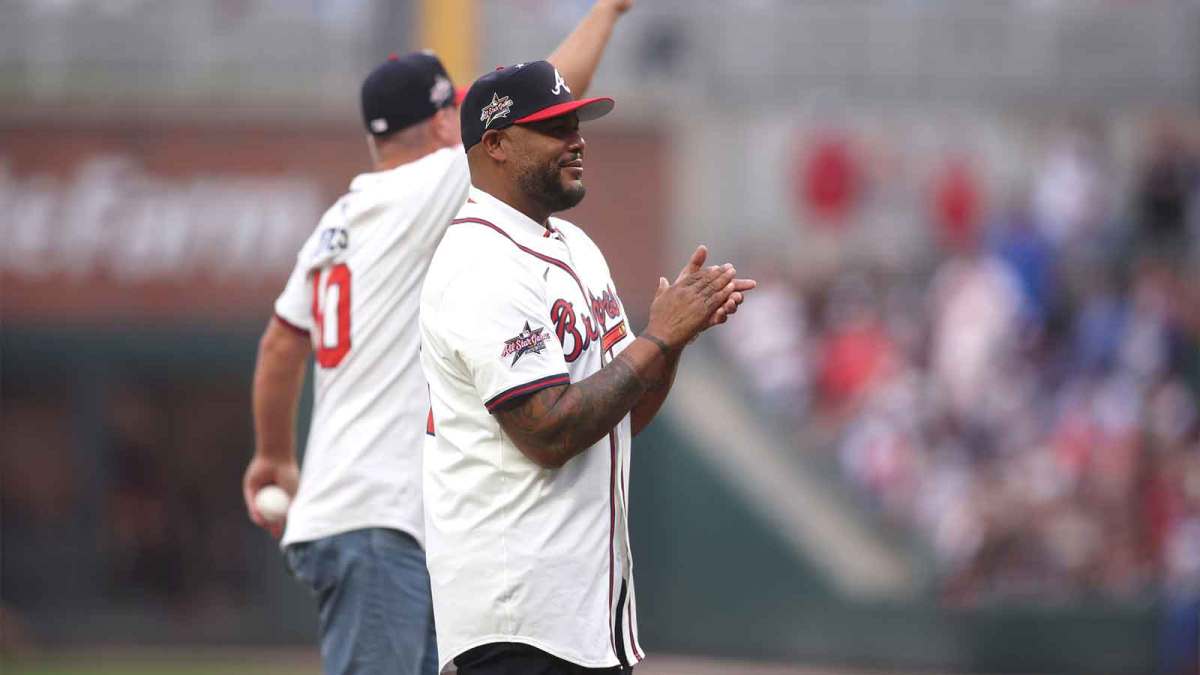
Andruw Jones’ Hall of Fame selection now stands as one of the most remarkable voting reversals in BBWAA history.
Jones was officially elected to the National Baseball Hall of Fame Tuesday, earning 78.4 percent of the vote in his ninth year on the ballot. The result completed a historic climb that began with a near miss and ended with induction into Cooperstown.
The former Atlanta Braves center fielder debuted on the Hall of Fame ballot in 2018 with just 7.3 percent support, the lowest ever for a player later elected to Cooperstown.
Over the next eight voting cycles, Jones steadily gained traction as voters reassessed his full body of work. His defensive dominance, postseason impact, and elite peak reshaped the conversation around his candidacy.
A graphic from MLB Network illustrates the magnitude of the climb, tracing Jones’ rise from the brink of ballot elimination to full induction.
With his Hall of Fame selection, Andruw Jones became the player with the lowest ever debut on the Hall of Fame ballot to end up earning the call from Cooperstown.
Image via @MLBNetwork pic.twitter.com/lBkMiMS028
— Joey Mistretta (@JoeyMistretta_) January 20, 2026
The 10-time Gold Glove winner’s election also marked a breakthrough moment for modern evaluation. While his career batting average and late-career decline initially limited support, advanced metrics reshaped the discussion and reframed his overall value.
Jones finished his career with 10 consecutive Gold Glove Awards and 434 home runs. He also recorded the highest defensive WAR ever posted by an outfielder.
The milestone carried global significance as well. He is the first player born in Curaçao to be inducted into the Hall of Fame, highlighting the island’s growing impact on Major League Baseball.
Jones enters the Class of 2026 alongside Carlos Beltran, elected by the BBWAA, and Jeff Kent, inducted through the Contemporary Baseball Era Committee.
He also joins a storied Braves Hall of Fame lineage that includes Greg Maddux, Tom Glavine, John Smoltz, Chipper Jones, Fred McGriff, manager Bobby Cox, and many more club legends.
The induction ceremony is scheduled for July 26 in Cooperstown. Jones’ journey to the Hall now stands as a defining example of how Hall of Fame voting continues to evolve, blending traditional achievement with modern evaluation. His election reflects a growing willingness to reassess greatness through a broader, more complete lens.